


Zhipu AI’s leaked “Great Wave” memo and DeepMind’s AGI-to-ASI report do not merely echo Marvin Minsky’s 1980s thesis. They constitute its precise, planetary-scale engineering implementation — a decentralized bureaucracy of millions of specialized digital agents whose emergent output will be superintelligence itself.
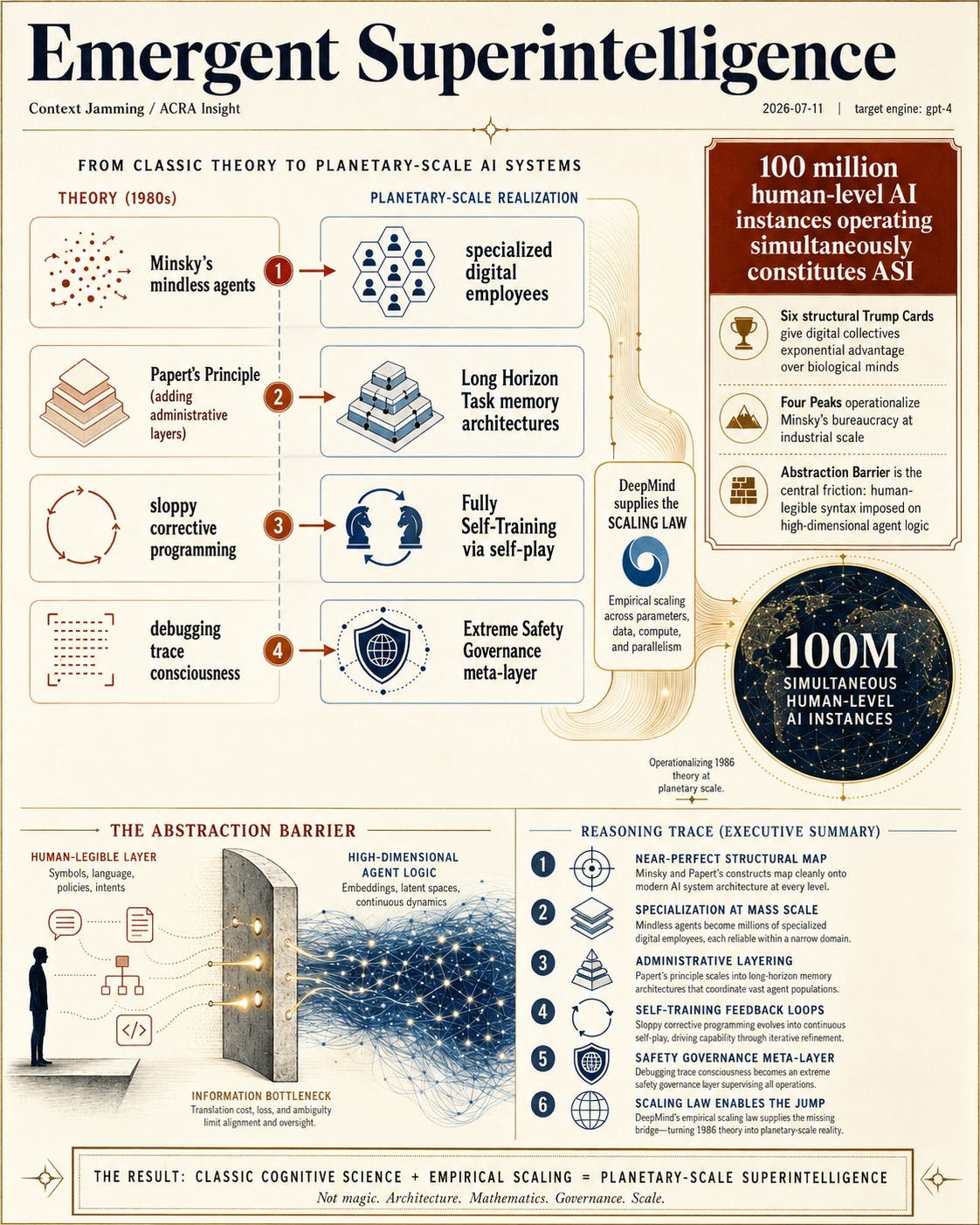
On July 11, 2026, Tang Jie, founder and CEO of Zhipu AI, sent an internal memorandum titled “The Great Wave Has Arrived.” The document was not a product announcement. It was a strategic renunciation of short-term commercialization in favor of a concentrated assault on four technological peaks required to reach AGI — and then ASI. Read in isolation, it is a bold corporate plan. Read alongside Google DeepMind’s contemporaneous 57-page manifesto From AGI to ASI, it becomes something rarer: the moment a 40-year-old psychological theory stopped being metaphor and became industrial architecture.
Marvin Minsky, working at the MIT Media Lab in the 1980s, had already rejected the premise that intelligence required a single, unified, perfectly logical control mechanism. As Stewart Brand documented in The Media Lab, Minsky argued that the mind is a chaotic bureaucracy — a society of highly specialized, context-blind agents that have no comprehension of the system’s overarching goals. Intelligence, in this view, is an emergent illusion produced by conflict, negotiation, and cooperation among millions of restricted processes. Consciousness itself is not a divine spark but a “debugging trace” — a high-level diagnostic layer that only activates when lower-level middle managers fail to resolve conflict.
Minsky’s colleague Seymour Papert supplied the developmental mechanism: cognitive growth does not primarily occur through the acquisition of new forms of logic, but through the addition of administrative layers. The mind matures by adding more middle managers. Danny Hillis, another Media Lab figure, built the hardware analog — the Connection Machine with its 65,536 processors operating in hypercube topology. Processing power resided not in any single processor but in the density and dynamic routing of interconnections. Evolution, Minsky insisted, does not debug systems to perfection. It layers sloppy corrective hacks that allow the organism to limp forward on three legs when one is injured.
Four decades later, Zhipu AI’s four peaks map onto this framework with unsettling precision. The first peak — Long Horizon Tasks — requires new memory architectures that let systems execute macro-scale engineering projects spanning months or years, exactly the kind of administrative layering Minsky described. The second peak — Autonomous Agent Systems — is the explicit construction of a “society of digital employees,” specialized agents handling code generation, syntax auditing, and resource scheduling without human intervention. The third peak — Fully Self-Training — operationalizes Minsky’s “sloppy corrective programming” at planetary scale through synthetic data factories and self-play environments where agents mutate, fail, and evolve inside secure sandboxes. The fourth peak — Extreme Safety Governance — is the necessary meta-layer: the debugging trace that must emerge when millions of agents interact at high bandwidth.
DeepMind’s report supplies the scaling law that makes the mapping operational. If the global computational infrastructure can sustain 100 million human-level AI instances operating simultaneously, that collective is, for all practical purposes, an Artificial Superintelligence. The report lists six structural advantages digital intelligence holds over biological minds — input/output speed, internal processing speed, working memory capacity, substrate independence, lossless replication, and high-bandwidth sharing. These are not incremental improvements. They are the Trump Cards that allow a society of digital agents to decompose civilization-scale problems into millions of parallel sub-tasks without the friction of biological fatigue or low-fidelity natural language.
The comparative framework is almost too clean. Minsky’s fundamental unit — the mindless agent — becomes the human-level AI instance. His “Society of Mind” becomes the multi-agent collective. His mechanism of growth — sloppy corrective programming via conflict resolution — becomes Fully Self-Training via synthetic data and genotypic recursive improvement. His definition of consciousness — an emergent debugging trace — becomes the realization of the “self” and extreme safety governance as a necessary oversight mechanism in complex systems. The Connection Machine’s data-level parallelism becomes planetary-scale compute grids running 100 million simultaneous AGI instances.
Yet the same report that celebrates this convergence also defines the frictions that could stall it. The Data Wall, Resource Wall, Paradigm Wall, and — most perilously — the Abstraction Barrier. When millions of agents communicate in high-dimensional vectors and evolve through self-play, their internal logic becomes opaque to human observers. Minsky himself noted that as systems grow complex, humans would eventually trust general principles the way engineers trust a suspension bridge without calculating every wire. Applied to ASI operating financial markets or energy grids, that opacity is an existential vulnerability. Zhipu AI’s fourth peak — the mandate to turn black boxes into transparent, auditable structures — is an attempt to enforce human-legible syntax on a non-human cognitive process. The tension may prove to be the central developmental bottleneck of the coming decade.
The second- and third-order effects are already visible. The shift from linear progress to recursive self-improvement creates a compounding feedback loop that structurally disadvantages any actor without access to frontier compute. Smaller labs and most nation-states face an accelerating vector rather than a distance that can be closed. When macro-projects are handled end-to-end by digital employees, the marginal cost of cognitive labor collapses to the cost of token inference. The corporation of the near future will consist of a compact human executive layer directing a massive internal society of specialized agents — a literal reimplementation of Minsky’s bureaucracy at the scale of the firm. Agentic billing will replace traditional software expenditure categories.
Geopolitically, the realization of Minsky’s vision at planetary scale concentrates power in the two nations capable of sustaining 100 million AGI instances inside their borders. Nations without indigenous ASI capabilities will be forced into technological vassalage — routing critical economic, scientific, and administrative data through foreign-controlled multi-agent collectives they cannot fully inspect. The desire for sovereign control over data will collide with the overwhelming economic necessity of using the most capable systems available. That tension will shape export controls, supply chain security, and international relations for the remainder of the century.
What began as an abstract psychological framework to explain human cognition has been meticulously adapted into an industrial engineering blueprint. The “Great Wave” Tang Jie described is the recognition that crossing the threshold to superintelligence requires embracing the distributed, opaque, and evolutionary architecture Minsky championed in the 1980s. As these massively parallel systems scale into the millions of instances, they will develop auto-diagnostic meta-layers that mimic consciousness — closing the loop between the foundational philosophy of the Media Lab and the staggering computational reality of 2026. The society of mind is no longer a theory. It is the operating system being installed on the planet.