The $80 Billion Ghost: Why a majority of Enterprise AI Fails (and the "Agentic Harness" That Fixes It)

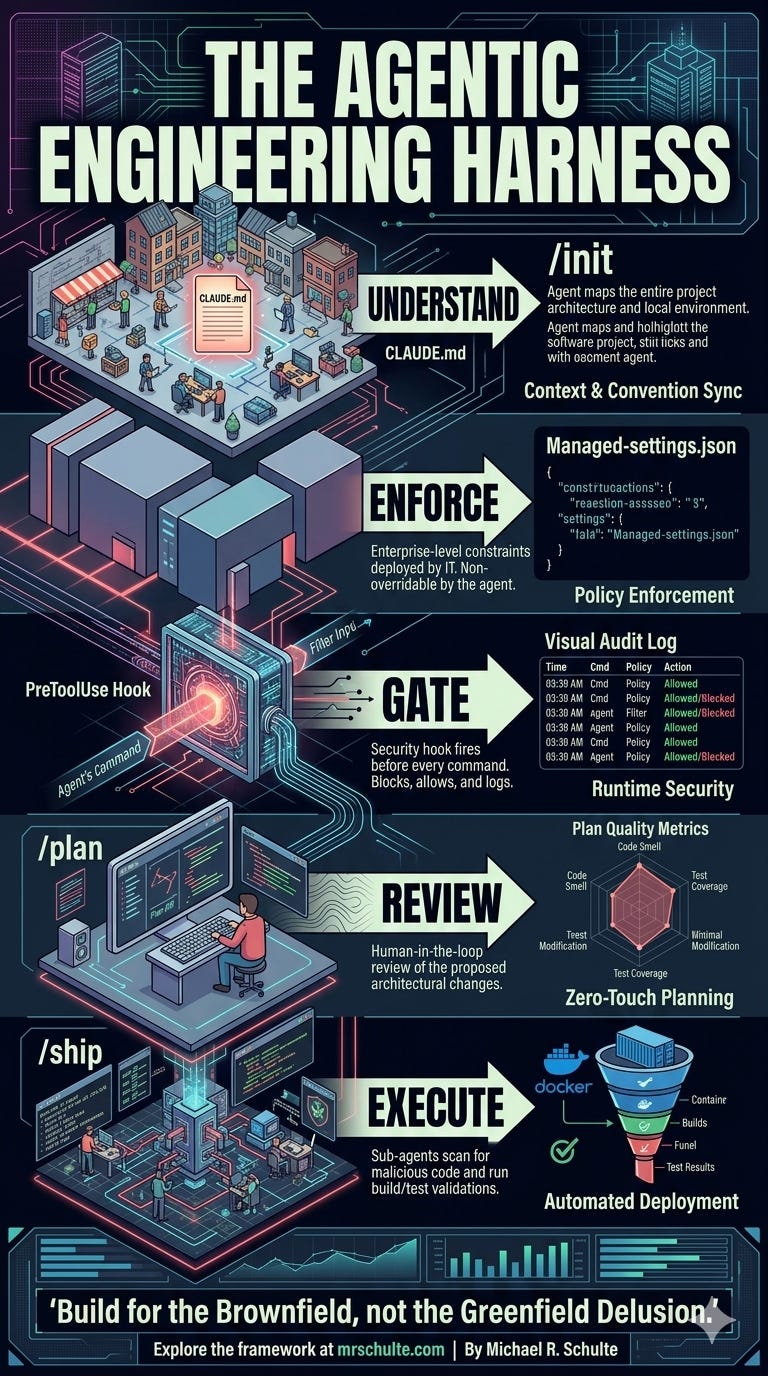
Insights from Michael R. Schulte’s live demo at Microsoft NERD on moving past the "Greenfield Delusion" and into production-grade Agentic Engineering.
The numbers are haunting. Between $70 and $80 billion has been poured into enterprise AI pilots, yet 95% of them have delivered zero measurable business return. According to Michael R. Schulte—HBS Guest Instructor and Technical Founder—the industry is suffering from a "Greenfield Delusion." We are treating AI like a magic wand for new projects, when the real value (and the real mess) lies in the "Brownfield": the 500,000+ line monorepos that actually run the world.
Beyond the Chatbot
During his recent talk at the Microsoft NERD center in Cambridge, Schulte demonstrated that the era of "chatting with your code" is over. If you want ROI, you don't need a more talkative model; you need an Agentic Engineering Harness.
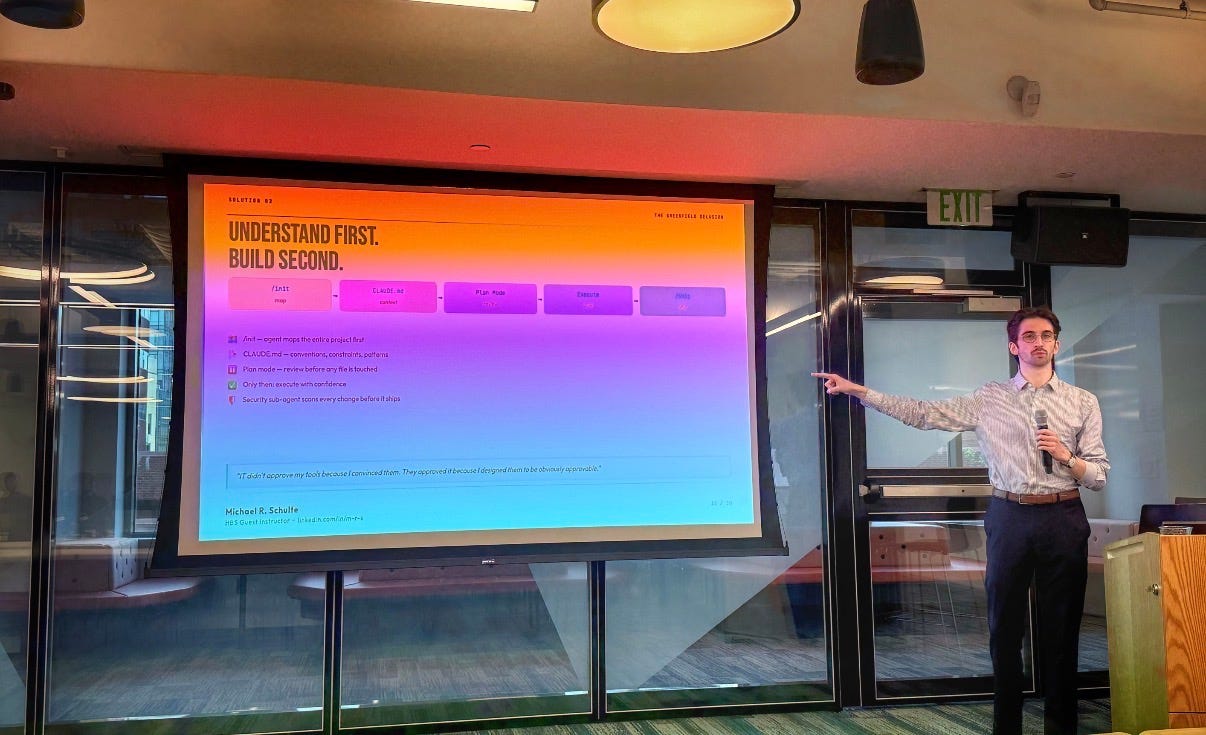
Using Claude Code, Schulte showed how to wrap a probabilistic model in a deterministic cage. The goal isn't just to write code—it’s to navigate complexity. When you drop an agent into a project like Cal.com, it doesn't start by "hallucinating" a solution. It starts with /init.
The Deterministic Gate: Pre-Tool Use Hooks
The most striking part of Schulte’s framework is the move from "asking" the AI to be safe to "forcing" it to be safe. He detailed a security architecture that should be the gold standard for any CTO:
1. Managed Settings: System-level JSON files that the agent cannot edit or override.
2. The Security Gate: A PreToolUse hook that fires before every single command.
3. The Audit Loop: If the agent tries to run a malicious or out-of-scope command, the OS kills the process before the CPU even sees the instruction.
As Schulte put it: "IT didn’t approve my tools because I convinced them. They approved it because I designed them to be obviously approvable."
The New Developer Rhythm
The demo concluded with a shift in the developer’s "craft." We are moving away from manual syntax writing and into a three-stage agentic loop:
• /init: The agent maps the environment and reads the CLAUDE.md conventions.
• /plan: A review mode where the agent proposes changes before a single file is touched.
• /ship: A multi-agent validation sequence that checks for malicious code, runs Docker builds, and verifies policy enforcement.
The Takeaway
In a world where execution is becoming a commodity—Schulte even noted that his presentation slides were built entirely by Claude—the remaining "moats" for humans are Taste and Architectural Strategy. The "Agentic Workplace" isn't about replacing the developer; it's about providing them with a surgical harness to operate on the complex, existing systems that represent the actual value of the enterprise.